
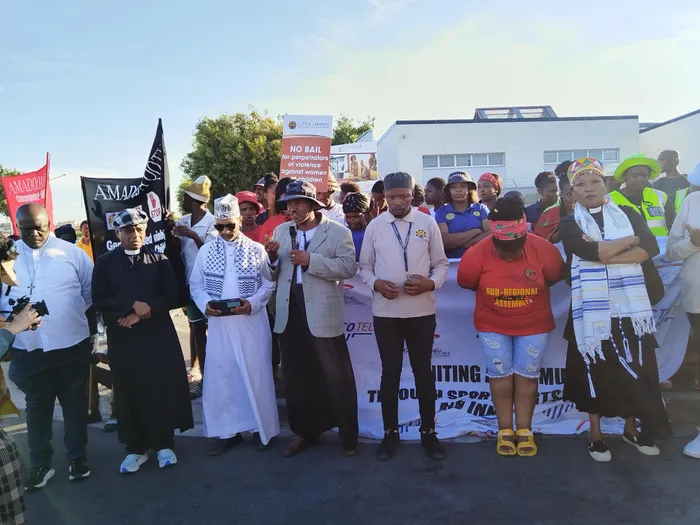
Faith leaders praying for a better country and peace in the Cape Flats.
Image: Phiri Cawe
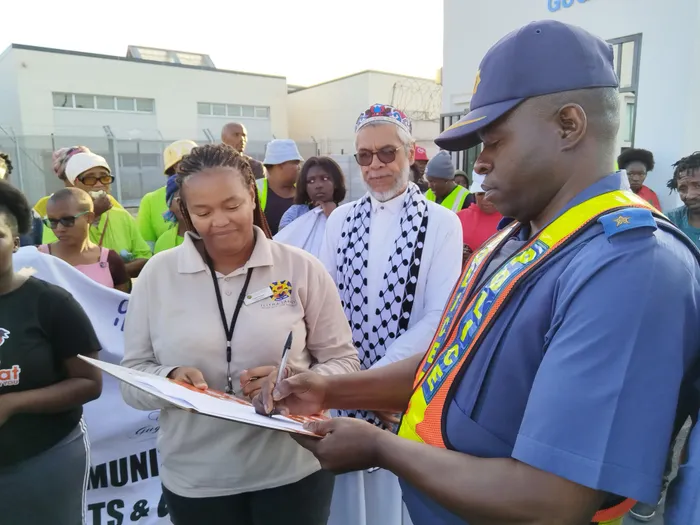
Ilitha Labantu legal advisor Unathi Pangwa handing over the memorandum to the Gugulethu police station commander, Colonel Soyiso Mantyi.
Image: Phiri Cawe
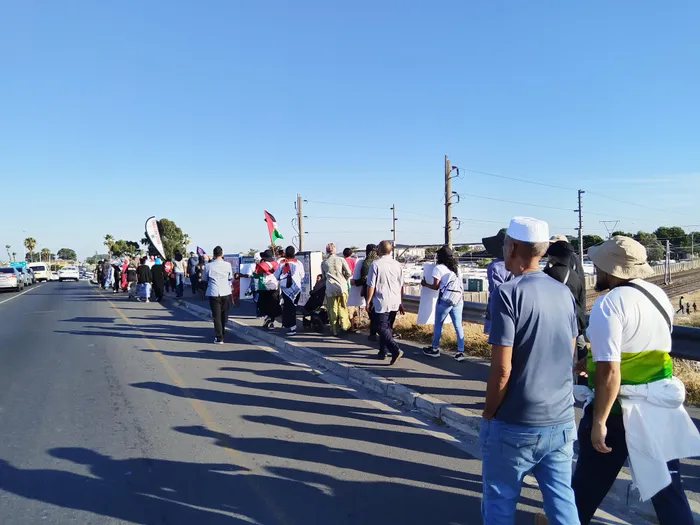
Manenberg residents crossing the railway line that divides them from Guglethu.
Image: Phiri Cawe

Concerned about crime, Gugulethu residents march to the police station to hand over a memorandum.
Image: Phiri Cawe
Residents of Gugulethu and Manenberg gathered on Friday night to stand together against crime in their communities. They met at the Gugulethu and Manenberg police stations before marching through their neighbourhoods to call for safer streets and an end to violence, gangsterism, and substance abuse.
The strong turnout highlighted the communities’ growing determination to reclaim their areas from criminal elements. The march, held under the banner of "Take Back the Night," formed part of the 16 Days of Activism for No Violence Against Women and Children campaign, which runs annually to raise awareness about gender-based violence and the abuse of women and children.
The event was organised in partnership with Gugulethu police and supported by various stakeholders, including non-governmental organisations, community structures, faith-based organisations, Metro Police, Neighbourhood Watch groups, Community Policing Forums, and residents.
The march symbolised solidarity not only between Gugulethu and Manenberg but also across communities on the Cape Flats, which continue to face similar social and safety challenges.

Don't Look Away.
Image: Supplied
Following the marches through the streets, residents gathered for a programme that featured several speakers, including local leaders, survivors, police officers, and representatives from support organisations.
Unati Pangwa of Ilitha Labantu formally handed over a memorandum detailing the community’s demands and concerns in Gugulethu, and Imam Rashied Omar of the Cape Crime Crisis in Manenberg.
Marchers raised serious concerns about what they described as a lack of political will to decisively confront the high levels of crime, gender-based violence, and rape affecting their communities. Among their key demands were strengthened visible policing in identified high-risk areas, particularly during early morning and late evening hours when many residents travel to and from work and school.
They further called for urgent, sensitive, and professional responses to incidents of gender-based violence, rape, and all forms of abuse involving women, children, and vulnerable persons. The memorandum stressed the need for cases to not only be opened at police stations but actively investigated and pursued to completion, with survivors kept informed and supported throughout the legal process.
Marchers also demanded stronger collaboration between police, community organisations, and safety partners to implement sustainable, community-based protection measures. They emphasised that all reports of crime and violence must be treated with dignity and seriousness, without prejudice, victim-blaming, or dismissive conduct.
According to Ilitha Labantu’s Ludwe Nkomo, the march represented a collective stand against ongoing violence targeting women and children, as well as the rising levels of crime that continue to affect the communities, especially during the festive season.
“The Take Back the Night march provided a space for unity and collective action. It allowed communities to make their voices heard and to confront the persistent violence that has become part of their daily reality,” said Mr Nkomo.
He stated that the message from communities was clear - every person has the right to live free from fear.
“Safety is not a privilege; it is a fundamental right. Women, children, and all vulnerable persons must be protected in their homes, on their streets, and in all public spaces,” he said.
Mr Nkomo acknowledged that policing alone could not end the crisis of violence but stressed that the police hold a critical responsibility in ensuring accountability and safeguarding communities. He urged the police to take immediate and decisive steps to strengthen their response and rebuild trust with the communities they serve.
“This memorandum reflects the lived realities of our communities and calls for urgent action. The right to safety is non-negotiable,” he said.
Imam Rashied Omar emphasised the importance of unity across the Cape Flats.
“Today we stand together. This is a moment where we are showing that the Cape Flats does not belong to one community only. It stretches from Manenberg to Gugulethu, from Mitchells Plain to Khayelitsha. We are all marginalised, and we are all affected. We are going to fight gender-based violence, gangsterism, and crime together,” he said.
He added that every person in the community deserves to live without fear and criticised those in positions of power for attempting to divide communities. Reflecting on the past, he noted that during the anti-apartheid years, residents from Manenberg would cross over to Gugulethu and often face arrest.
“It is deeply worrying that racism and division are still rooted in the Cape Metro. This is not a single city; it remains a divided city. Events like today must be repeated across the Cape Flats, everywhere,” he said.
Imam Omar also raised concerns about limited police resources and alleged corruption at higher levels, saying these challenges continue to weaken effective crime-fighting efforts. However, he expressed hope that trust between the police and communities could be rebuilt through honest engagement and accountability.
Accepting the memorandum in Gugulethu, station commander Colonel Soyiso Mantyi thanked the marchers and promised that the concerns would be forwarded to his superiors. He said he hoped the unity demonstrated would not go unnoticed. In Manenberg, the memorandum was accepted by Captain Jansen.