
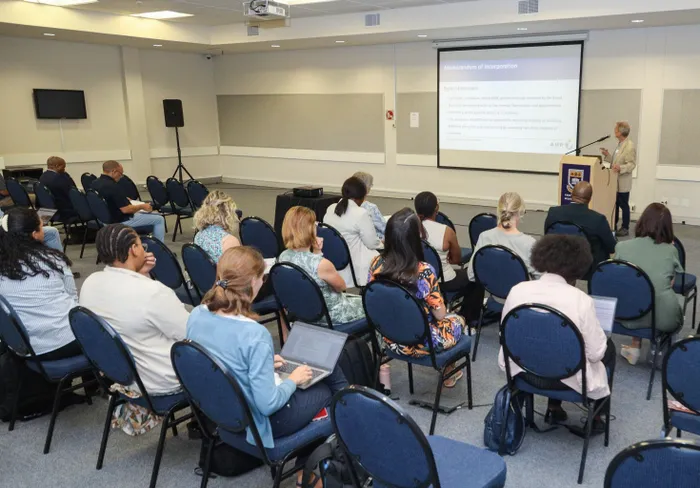
Stakeholders at the recent launch of the Absorbent Hygiene Products (AHP) Waste Forum at the University of the Western Cape.
Image: UWC
New research showing that disposable nappies can take up to 500 years to decompose, and that South Africa generates about 900 000 tons of nappy waste annually, has prompted renewed calls for urgent intervention in the country’s waste management sector.
The findings, from a 2024 study led by Professor Rinie Schenck and colleagues at the University of the Western Cape (UWC), were presented during the recent launch of the Absorbent Hygiene Products (AHP) Waste Forum at UWC.
The forum, co-chaired by Prof Schenck and Dr Marc Kalina from UWC’s Centre for Interdisciplinary Studies of Children, Families, and Society (CISCFS), aims to address the growing environmental and public health risks posed by used nappies and sanitary products.
According to Dr Kalina, access to basic waste services remains deeply unequal across the country.
"We are either getting no waste management services, such as in rural areas where people have to make their own plan, or in urban settlements or townships where the waste management services are not nearly adequate for the number of people living there.
“And as a result, there is an immense amount of waste that ends up in the environment. People have to live in communities full of their own waste, with consequences for people, particularly children’s health and the environment,” said Dr Kalina.
Professor Schenck said roughly 40% of households in rural and informal areas do not receive waste collection. Unable to burn nappies, residents often bury them or dump them in rivers and open spaces, leading to widespread pollution.
The AHP Waste Forum is expected to play a key role in informing the Department of Forestry, Fisheries and the Environment’s (DFFE) national AHP Waste Management Strategy.
The initiative began in 2021 with data-gathering projects aimed at better understanding the scale and impact of nappy waste. The forum now brings together stakeholders from government, the private sector, non-governmental organisations, academia, and communities.