
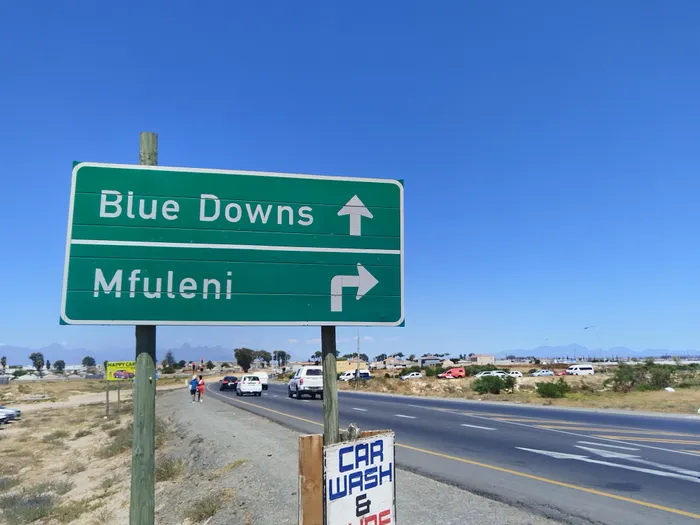
Mfuleni Police Station has recorded the highest levels of crime in the country, according to recent crime statistics.
Image: Phiri Cawe

Mfuleni police station.
Image: Phiri Cawe
The recently released national crime statistics for the second quarter this year show that Mfuleni Police Station has recorded the highest levels of crime in the country, appearing in almost every category of the national top 30 crime rankings.
The statistics cover the period from Tuesday, April 1, to Tuesday, September 30, this year.
Station commander Brigadier Tamsanqa Tito said the fact that Mfuleni tops multiple serious crime categories is a concern requiring intervention, and he linked the high crime levels to ongoing gang violence and extortion networks that continue to destabilise the area.
The statistics place Mfuleni at the top of the national and provincial lists for murder and common assault, with reported cases ranging between 386 and 390.
The station again ranked first in the province for robbery with aggravating circumstances, recording 270 to 325 cases, followed by Nyanga with 353 to 286, and Harare in third position.
While Mfuleni recorded a slight decline in sexual offences - dropping from 55 to 52 cases - it still tops the category in the province. Nationally, it ranks 10th in rape, again showing a slight decrease from 46 to 45 cases. In the overall contact crime category, Mfuleni leads both provincially and nationally with 1 111 cases, up from 1 013 during the same period last year.
In contrast, Nyanga, while reporting fewer cases than in previous quarters, remains the second-highest contact crime area, with figures ranging from 797 to 931. Nyanga’s rape cases increased from 126 to 151, but the area recorded a decrease in murders, dropping from 79 to 58.
Other stations with high murder totals include Gugulethu, Philippi East, and Harare, all of which also feature in the national top 30
Brigadier Tito said targeted interventions are already in motion to curb the spiralling crime levels. One major hotspot, Westbank, has seen an intensified police deployment due to ongoing gang-related murders.
“We have serious challenges, especially with assaults,” he said.
“We now need to ensure the perpetrators are arrested and denied bail. Murders have subsided in Westbank after the increased deployment. The biggest issue has been multiple murders.”
He added that the government had committed to establishing a satellite police station, which he believes will ease the strain on existing resources. Brigadier Tito also appealed to residents to work more closely with the police in reporting crime and supporting investigations.
Mfuleni residents expressed frustration and disappointment following the release of the statistics. Community leader and Community Police Forum (CPF) public relations officer Mvano Magula said it was "heartbreaking" to see the community topping crime statistics for the second year in a row.
“Being number one in the country is not a good thing,” he said.
"Being number one in murder is not a good thing. Being number three in rape nationally cannot be something we celebrate. It is scary and disappointing.”
Mr Magula attributed part of the crisis to the chronic lack of policing resources in Mfuleni. According to him, the station operates with only three patrol vans covering three large sectors.
“Staff shortages are a well-known problem. Yes, we lack resources, but that does not justify crime levels this high. I am honestly lost for words.”
Another community leader, Malibongwe Yisa, linked the rising crime to the rapid expansion of Mfuleni, fuelled by new informal settlements and recent boundary demarcations.
“We are concerned and worried. As leaders and residents, we are trying our best. Our only hope is that crime will eventually be defeated.”
Nyanga CPF secretary Dumisani Qwebe said that for crime to be meaningfully reduced, neighbouring stations must form more collaborative policing strategies.
“Imagine Nyanga, Philippi East, and Gugulethu working together. Imagine Mfuleni combining efforts with the stations close to it. This approach could solve many of our challenges.”
Mr Qwebe said he was encouraged by Nyanga’s slight improvements but insisted that the long-term goal remains to completely exit the top 30 crime list.
“We are progressing slowly, and the numbers show it. But true success will be when we are no longer in the top 30.”
He urged residents to stop relying solely on government and policing structures, calling on communities to participate actively in safety initiatives. He commended Nyanga police for their school and church visits, which he said help strengthen crime awareness and prevention efforts.
During a gender-based violence and femicide (GBVF) event in Khayelitsha last Thursday, Khayelitsha police sub-district commander Brigadier Magobiyane praised progress in crime fighting but remained concerned about persistently high GBV rates in Khayelitsha, Makhaza, Harare, and Lingelethu West, all of which continue to appear in national crime reports.